Custom Website Development
We design and build your site from scratch on Next.js: no template, no page-builder plugin stack to outgrow later.
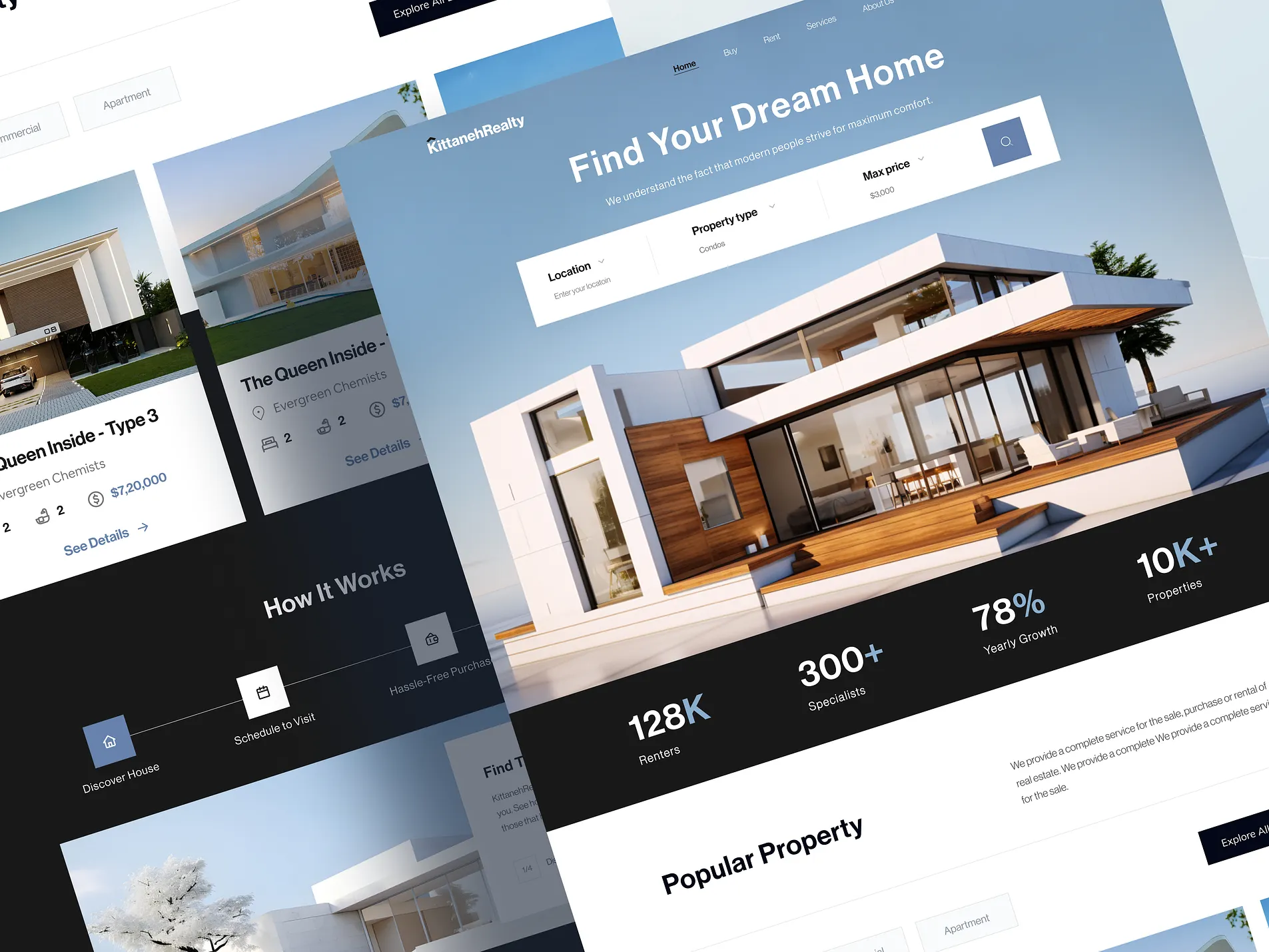
Most business websites are slow because they were assembled, not engineered. We build yours on Next.js, server-rendered and scoring 90+ on Core Web Vitals, so Google ranks it and visitors don't wait for a spinner. You get senior EU engineering, full code ownership and GDPR compliance by default, for less than a London or Berlin agency charges. Already have a site? Send us the URL and we'll tell you what is costing you speed and rankings.
We design and build your site from scratch on Next.js: no template, no page-builder plugin stack to outgrow later.
Loads in under a second so visitors stay instead of bouncing, and SEO is built into the code, not bolted on. You own everything: no monthly platform fees, no lock-in.
We start by looking at what you have (or your project brief if you're starting fresh), then build and launch in stages, so you see real progress along the way, not just one big reveal at the end.
Custom website performance is a direct revenue driver because Google uses Core Web Vitals as a ranking signal, and Akamai's 2017 retail performance study found that a 100ms delay cut conversion rates by up to 7%. Sites built on Next.js 16 with server-side rendering and edge caching reach sub-second load times that most template platforms struggle to match.
We engineer performance at the infrastructure level. Static Site Generation (SSG) pre-renders pages at build time, while Incremental Static Regeneration (ISR) keeps content fresh without rebuilding the entire site. The result is a Largest Contentful Paint (LCP) under 1.2 seconds on mobile.
Performance is not a feature we add after launch. It is an architectural decision made on day one that compounds over the lifetime of your site.
Your website and your content system don't have to be the same piece of software, and keeping them separate is what makes a site both faster and harder to hack. This pattern is called decoupled architecture: it separates the frontend (what visitors see) from the backend (where your content lives), so your content management system is never publicly accessible, eliminating the single point of failure that monolithic platforms like WordPress expose.
WordPress runs 43% of all websites (W3Techs) and is the most-targeted CMS by attackers, over 90,000 attacks per minute according to Wordfence data. Our headless architecture using Next.js 16 and Sanity CMS has no public-facing admin panel, no plugin dependencies, and no database directly exposed to the internet.
Scalability follows the same principle. When traffic spikes, the static frontend scales through CDN distribution without touching your data layer. A traffic spike is served from the CDN, so there are no emergency server upgrades and no slowdown for visitors.
You get a website that grows with your business without accumulating the technical debt that forces a rebuild every two to three years.
Conversion-optimised web design applies behavioural psychology principles to interface structure, reducing friction between a visitor's intent and your desired action. Research from the Baymard Institute shows that 69.82% of online shopping carts are abandoned, with poor UX cited as the primary non-price factor.
We design every page around a single conversion goal. Visual hierarchy directs attention to your primary CTA. Form fields are cut to the minimum required: every additional field costs completions. Mobile-first layouts ensure visitors arriving on smartphones encounter zero horizontal scrolling or misaligned elements.
Our process includes heatmap analysis with PostHog, scroll-depth tracking, and A/B testing infrastructure built into the initial deployment. Design decisions are validated with data, not assumptions.
The difference between a beautiful website and a converting website is measurable. We build for the metric that matters to your business, whether that is demo requests, purchases, or qualified lead submissions.
Technical SEO is the practice of optimising a website's infrastructure so search engines can crawl, index, and rank its content efficiently. When SEO is treated as an afterthought, added via plugins or manual meta tags, critical elements like structured data, canonical URLs, and hreflang tags are often incomplete or inconsistent. Our approach embeds SEO into the build process itself.
Every page ships with JSON-LD structured data, automatically generated XML sitemaps, Open Graph and Twitter Card meta tags, and canonical URL management. For multilingual sites, hreflang annotations are generated programmatically across all locale variants: Croatian, English, German and beyond.
Next.js 16 with React Server Components ensures Google receives fully rendered HTML on first request, eliminating the indexing delays common with client-side JavaScript frameworks. Combined with Core Web Vitals scores above 90, that gives a new site a clean technical base to rank from.
On every website we build, SEO is standard engineering practice, not an add-on.
Custom website development with Neviox gives you 100% ownership of your source code, intellectual property, and hosting infrastructure, unlike platform-dependent solutions where your business operates on rented technology. Owning the code is an asset in any due diligence, and it removes vendor lock-in risk.
We operate as a long-term engineering partner, not a project vendor. After launch, our structured maintenance agreements cover security patching, dependency updates, performance monitoring, and feature roadmap planning. A team that already knows your codebase ships changes faster than one that has to onboard first, which is why we offer ongoing maintenance after launch.
All code is documented with TypeScript 6 strict typing, tested, and stored in your own Git repository. If you choose to bring development in-house or switch providers, the handover is clean and complete.
The cost advantage of working with senior EU engineers in Croatia means you invest the savings into features, marketing, or maintenance rather than absorbing inflated agency overhead.
Custom website development covers a range of architectures, each requiring different technology decisions based on the site's business objective. We deliver four primary project types, all built on Next.js 16 with TypeScript 6 and headless CMS integration as standard.
Corporate and Brand Websites: Multi-page sites that position your company, communicate services, and generate qualified leads. Built with Next.js 16 and Sanity CMS so your team manages content independently. JSON-LD structured data, ISR for always-fresh content, and Core Web Vitals optimisation included.
SaaS Marketing Sites: High-conversion landing pages and product marketing websites for software companies. Performance-optimised for Core Web Vitals, instrumented with PostHog analytics, and built to support A/B testing from day one.
Multilingual B2B Portals: Full i18n support using next-intl. Croatian, English, German, and beyond, with proper hreflang implementation, locale-specific content, and SEO-optimised URL structures per language.
Industry-Specific Platforms: Tourism portals with booking integration, real estate sites connected to agency CRMs, healthcare clinic sites with appointment scheduling, and educational platforms, each built to the specific workflow of the industry it serves.
What Every Project Includes as Standard: JSON-LD structured data, XML sitemap generation, Open Graph tags, canonical URL management, accessible markup following WCAG 2.2, and Core Web Vitals optimisation are included in every engagement, not sold as add-ons.
Choosing between custom development, WordPress, and Wix depends on your performance requirements, security posture, and long-term cost tolerance. Custom Next.js builds consistently outperform template platforms on Core Web Vitals, SEO control, and total cost of ownership over a 3-year period, while giving you full code ownership and zero platform fees.
| Feature | Custom (Neviox) | WordPress | Wix / Squarespace |
|---|---|---|---|
| Loading speed (Core Web Vitals) | Engineered to milliseconds | Plugin-dependent | Limited |
| SEO control | Full | Partial (plugins) | Basic |
| Design customisation | Unlimited | Templates + overrides | Templates only |
| Security | Hardened, no public admin panel | Most-targeted CMS | Platform-managed |
| Scalability | Enterprise-grade | Requires optimisation | Capped |
| Long-term cost | Predictable, no licences | Plugins + hosting costs | Growing subscription |
| Code ownership | Fully yours | Partial | Platform lock-in |
| AI / API integration | Native | Complex | Limited |
Don't need a new site? Small, clearly scoped work on the one you already have.
If your existing site just needs to load faster or needs a safe framework upgrade, you don't need a new project. We take on small, clearly scoped jobs with a price estimate before we start.
Page speed fix (Core Web Vitals)
LCP, image and script loading optimization.
Next.js version upgrade
Safe upgrade to a newer version with regression checks.
Get a ballpark in about a minute. Pick the project type and features and see the number we would start from. It is an estimate: the final price comes after we have looked at your scope.
Real reviews from Clutch and Google, not written for this page.
“Every aspect of the project was delivered on time and as requested.”

“Thanks to Neviox Digital's work, Poliklinika Meter achieved a significantly improved digital presence, faster page loads, and a more intuitive user experience on their website. The team delivers reliably, communicates clearly, and responds quickly to needs. Neviox Digital provided expert guidance and tailored solutions throughout the project.”
“Thanks to Neviox Digital's work, the client has seen a 40% increase in their custom search tool usage and a 25% increase in signups. The team delivers on time, communicates clearly, and responds quickly to needs. Neviox Digital has provided expert guidance throughout the engagement.”
“Great company, highly recommend”
“The website is very well designed, easy to navigate and overall experience feels smooth and professional. What impressed me the most was how simple and fast the whole process was. Highly recommended!”
“Every aspect of the project was delivered on time and as requested.”
“Thanks to Neviox Digital's work, Poliklinika Meter achieved a significantly improved digital presence, faster page loads, and a more intuitive user experience on their website. The team delivers reliably, communicates clearly, and responds quickly to needs. Neviox Digital provided expert guidance and tailored solutions throughout the project.”
“Thanks to Neviox Digital's work, the client has seen a 40% increase in their custom search tool usage and a 25% increase in signups. The team delivers on time, communicates clearly, and responds quickly to needs. Neviox Digital has provided expert guidance throughout the engagement.”
“Great company, highly recommend”
“The website is very well designed, easy to navigate and overall experience feels smooth and professional. What impressed me the most was how simple and fast the whole process was. Highly recommended!”
“Every aspect of the project was delivered on time and as requested.”
“Thanks to Neviox Digital's work, Poliklinika Meter achieved a significantly improved digital presence, faster page loads, and a more intuitive user experience on their website. The team delivers reliably, communicates clearly, and responds quickly to needs. Neviox Digital provided expert guidance and tailored solutions throughout the project.”
“Thanks to Neviox Digital's work, the client has seen a 40% increase in their custom search tool usage and a 25% increase in signups. The team delivers on time, communicates clearly, and responds quickly to needs. Neviox Digital has provided expert guidance throughout the engagement.”
“Great company, highly recommend”
“The website is very well designed, easy to navigate and overall experience feels smooth and professional. What impressed me the most was how simple and fast the whole process was. Highly recommended!”


